


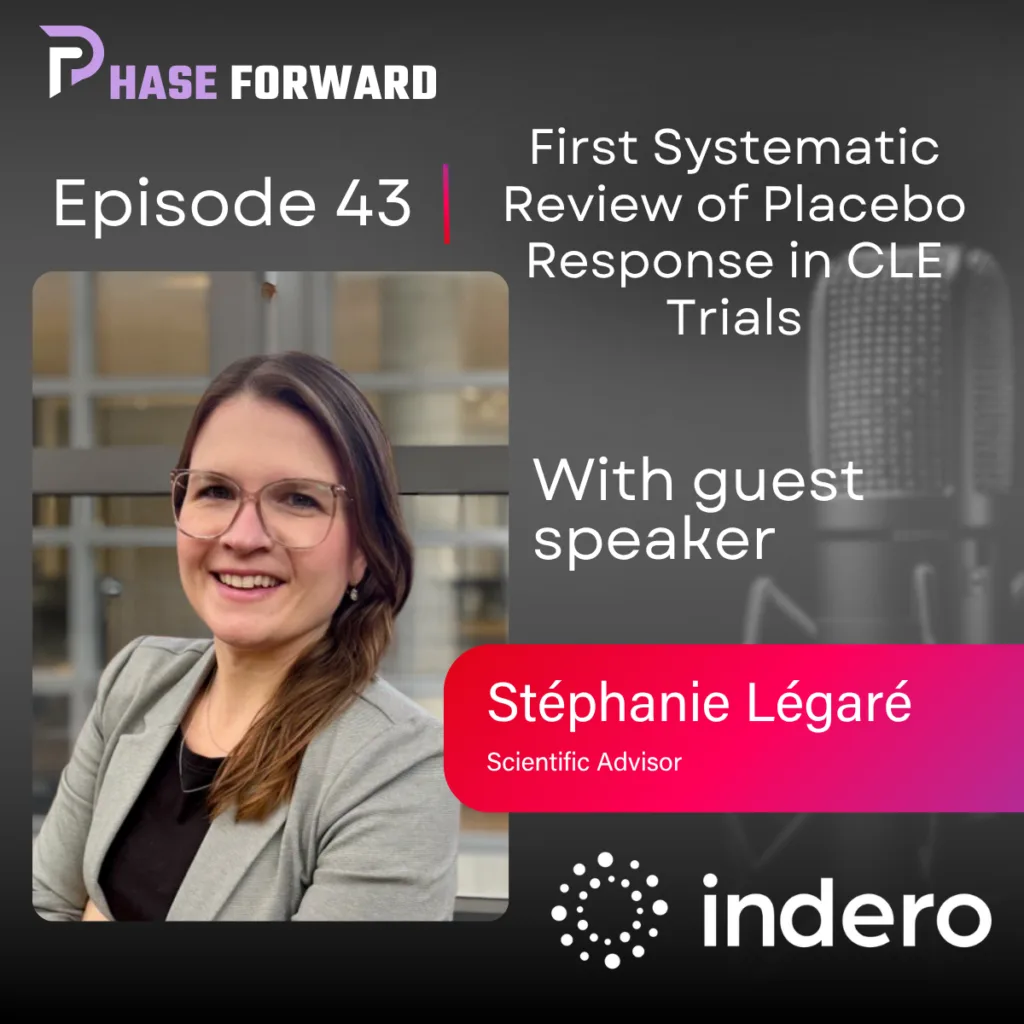
We’re joined by Dr. Stéphanie Légaré, Scientific Advisor, Indero, who has more than a decade of expertise in scientific medical communication, and translational and clinical research. She obtained her PhD in experimental medicine at McGill University, has taught biological sciences for several years, and has worked for eight years at Indero.
Stéphanie is first author on several peer-reviewed scientific publications, the most recent of which we are discussing today: Placebo Response in Randomized Controlled Trials of Systemic Therapies for CLE: A Systematic Review and Meta-Analysis published in August 2026 in Pharmaceutical Medicine. Her coauthors included Indero’s Sherry Lin, Sarah Vahey, Dr. Juan Ovalles, Pina D’Angelo, and Dr. Robert Bissonnette.
The topic aligns closely with Indero’s expertise in dermatology and rheumatology as cutaneous lupus erythematosus (CLE) is a form of lupus that affects the skin and sits at the intersection of these two therapeutic areas.
The scope of the review was impressive: the authors analyzed 33 randomized controlled trials described across 43 publications spanning almost 20 years, and including 2,382 placebo-treated participants.
Significant unmet need for CLE-specific therapies
CLE remains an underserved condition. Skin symptoms are common among patients with lupus: CLE is estimated to be two to three times more common than systemic lupus erythematosus (SLE), and approximately 70% to 85% of patients with SLE develop skin manifestations during the course of their disease.
Apart from hydroxychloroquine, approved for discoid lupus in the 1950s, no new therapy has been approved specifically for CLE in more than six decades! This substantial unmet need underscores the importance of research to support the development and evaluation of new therapies for patients with CLE.
Placebo response is a major challenge in rheumatology and dermatology clinical trials. Understanding its frequency and contributing factors can help sponsors optimize study design, sample-size calculations, outcome selection, and interpretation of results. The analysis included studies that varied considerably in eligibility criteria, patient populations, baseline disease severity, assessment timing, and outcome reporting.
Despite this variability, all included studies shared core design elements: they were double-blind, randomized, placebo-controlled trials evaluating a systemic therapy, and each assessed the Cutaneous Lupus Erythematosus Disease Area and Severity Index–Activity score (CLASI-A) at baseline and at least one post-baseline time point.
Comparing results across studies required careful consideration of how CLE populations were defined. Some trials enrolled patients with CLE with or without systemic manifestations, whereas others enrolled patients with SLE with or without cutaneous involvement. Analyses therefore focused specifically on participants with CLE, whether as isolated skin disease or in the context of systemic lupus.
Challenges in the analysis
Not all outcomes could be pooled in the same way. For example, CLASI-A50: the proportion of patients achieving at least a 50% improvement in CLASI-A from baseline was reported only among participants with a baseline CLASI-A score of at least 8 or 10.
In some other cases, such as the assessment of the change from baseline in CLASI-A over time, results were reported for all participants with a CLASI-A score above 0 at baseline, or as determined by the eligibility requirements.
These differences had to be considered to ensure that studies were pooled appropriately. Overall, the main challenge was to understand cross-study differences, extract data consistently, and translate the findings into clinically interpretable results.
All CLASI-A–based efficacy outcomes available in the literature were extracted, including change and percentage change from baseline, a four-point or greater improvement from baseline, and CLASI-A50. CLASI-A50 emerged as the most consistently reported endpoint, appearing in 19 of the 33 included trials and providing the strongest basis for cross-study comparison.
Beyond data availability, CLASI-A50 is a key endpoint in CLE trials because a 50% reduction in disease activity is widely regarded as clinically meaningful for patients. It was therefore a logical and clinically relevant endpoint for this analysis.
Several important data gaps limited the analyses. Not all studies were designed specifically for CLE; some enrolled patients with SLE who may or may not have had skin involvement. In certain studies, baseline data were available for the full population while CLASI-A50 outcomes were reported only for a subset. Consequently, baseline characteristics could not always be linked directly with placebo response, limiting some planned correlation analyses.
Questions for future study
The analysis identified several noteworthy signals, including a positive correlation between placebo response and the proportion of White participants at baseline. Because this finding was based on only five studies, it should be interpreted with caution. One possible explanation is measurement bias in erythema scoring, because redness can be more difficult to detect in darker skin tones.
Future trials should therefore incorporate investigator training in CLASI-A scoring across all Fitzpatrick skin types, standardized photography, and reference images representing a range of skin types. Because these analyses were based on study-level data, the findings require cautious interpretation. Nevertheless, they identify patterns that warrant closer evaluation in future CLE trials.
Placebo response rising over time
A notable finding was the increase in placebo response over time. In the pooled analysis, placebo response was approximately 21% at week 8, 33% at week 24, and 46% at week 52. This pattern has important implications for trial design. The timing of the primary endpoint may influence the magnitude of placebo response and, consequently, the ability to detect a treatment effect.
Several factors may contribute to rising placebo response over time, and no single driver can be isolated. CLE can fluctuate naturally, while patient expectations, greater engagement with the study team, and psychological or social influences may become more pronounced with longer follow-up.
From a trial-design perspective, if placebo response increases over time, selecting the earliest primary endpoint at which the investigational therapy is expected to achieve its maximal or near-maximal effect may help preserve the ability to detect a treatment difference. This consideration may be especially relevant in early-phase lupus trials, where the principal objectives are proof of concept and signal detection.
Contrary to validating that a growing number of refractory patients enrolled in newer studies is a factor in higher placebo responses, evidence extrapolated from rheumatoid arthritis, psoriasis, and inflammatory bowel disease indicates that prior exposure to or failure of available therapies is associated with lower placebo response. An increasingly refractory trial population would therefore be expected to attenuate, rather than amplify, the observed trend.
One possibility is that the profile of patients enrolled in CLE trials has changed over time. Earlier diagnosis, more consistent photoprotection, and more standardized background therapy may mean that participants in recent trials have shorter disease duration or more responsive disease.
These factors can amplify nonspecific improvements across treatment arms, including the placebo group. Prior treatment exposure and disease duration were not reported consistently enough to evaluate this hypothesis directly, but they remain important considerations for future CLE trial designs.
The pooled placebo response was 50% (95% CI 40-60) in trials requiring stable background therapy, compared with 36% (95% CI 27-46) in trials that did not. One possible explanation is that requiring background therapy may shift enrollment toward patients whose disease is already partially controlled, leaving less room for improvement. It can make the placebo arm function more like an active comparator.
Future trials should carefully consider the use of background therapy. Potential strategies include limiting its use during the initial efficacy window when feasible, implementing a longer run-in period before randomization, delaying rescue therapy until after the primary endpoint, and stratifying randomization by background-therapy use.
Warrants further study
An important unanswered question is whether responses in active-treatment arms also increase over time or whether this pattern is specific to placebo groups. The answer could materially affect the interpretation of treatment differences over longer follow-up.
If active-treatment responses have remained stable while placebo responses have increased, the narrowing treatment–placebo gap may help explain why some recent CLE trials have struggled to demonstrate statistical significance. If active-treatment responses have also increased, however, the treatment effect may remain intact. This question was not formally assessed in the paper and warrants further study.
For sponsors designing future CLE trials, key considerations include earlier primary endpoints, thoughtful management of background therapy, balanced representation across skin types, and more consistent reporting. Standardized reporting of key trial-design features, baseline characteristics, and outcomes can improve interpretation and cross-trial comparison.
Together, these measures can generate clearer, more clinically meaningful evidence that is useful to sponsors, clinicians, researchers, and, most importantly, patients.
Want more on placebo response in rheumatology trials? Learn from leading KOLs Drs. Andreas Kerschbaumer and Joan Merrill at a free educational breakfast event happening during ACR Convergence 2026.