
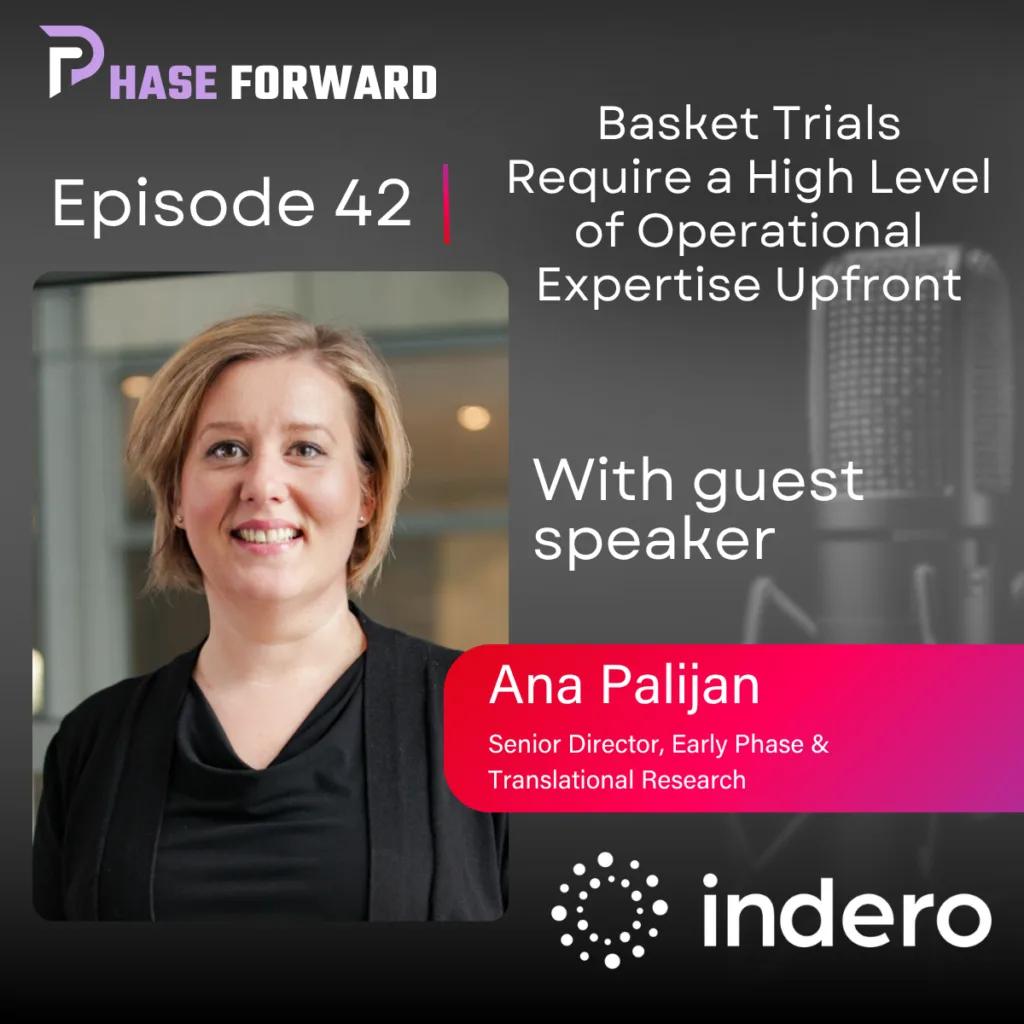
We sat down with Ana Palijan, Senior Director of Early Phase and Translational Research at Indero. She’s a strategic clinical development leader and innovating disruptor with almost 20 years’ experience spanning early phase clinical development, translational research, and biomarker-driven programs across many therapeutic areas, currently dermatology, and author of more than 40 peer-reviewed publications.
Today, we’re talking about basket trials and clinical research, specifically in early phase dermatology studies. A basket trial is where you have multiple diseases or indications within one master protocol, which has the vision of your trial, with these appendices, or sub-protocols, that target specific indications in a therapeutic area.
Earlier readouts enabled
Sponsors need earlier readouts to move their research program forward, both from a business strategic and clinical development perspective. The advantage of basket trial design is that the sub-protocols can be independent from each other. Let’s say, sub-protocol one is completed, but sub-protocol two has a longer enrollment requirement; you can still get a readout. As a sponsor, this brings a lot of advantages.
There is also much flexibility in a basket trial design; one part can be a trigger or gatekeeper to activate another sub-protocol. Or, if you’re not getting the efficacy you want in that one sub-protocol, you can stop it, but your trial overall is not stopped. You can still keep going.
MoA applicable to multiple indications
When it comes to which indication is suitable for basket trial within early phase dermatology, that really comes from the sponsor’s asset and the mechanism of action (MoA). Many times at the bench developing a new molecule, you see that the pathway or target of your asset is applicable in multiple different indications. As you’re developing your drug development program, you don’t know where to focus your later phase studies. But by having a basket trial designed for these different indications, it can really help you to target efficiently what you’re looking at.
Is there any indication that’s more popular versus not? Not necessarily. You can have atopic dermatitis (AD), psoriasis (PsO), alopecia areata (AA), hidradenitis suppurativa (HS)… you could put them all in one basket trial design if your molecule is that magical!
Is the buy-in at the front worth the downstream efficiencies?
The key element here is the design of it, the complexity of it. When you come into a basket design, there’s multiple things to think about because it’s a big buy-in and a front end for efficiencies downstream.
Where two indications have very different visit patterns, frequencies, length and so forth, having a basket design with these two indications in the same protocol can cause challenges in setting up the systems: building your electronic data capture (EDC) with auto dynamics, integration with your Interactive Response Technology (IRT), and all of that stuff. Are the buy-in and the front end worth the downstream efficiencies?
You really need to have a high level of operational expertise to set it up properly. When it’s set up properly, you do have the gains. But you think through: what is my readout? What do I need? What is the end-user experience for sites and patients?
The site and PI experience
Say a site participating in a basket study has a very big pool of patients with PsO, somewhat fewer patients with AD, and some patients with HS. How will you make it simple for this site to know which patient is under what indication? How do you label this patient in the system? As a Principal Investigator, what assessment do you need to do for this patient?
Tricky patient recruitment
You have to think about all that, and how you’re going to find these patients. You cannot just put out the ad: “We have a study for atopic dermatitis, psoriasis and hidradenitis suppurativa.” The potential trial participant will think, “Oh I don’t have HS, I cannot participate in this.” So again, it’s really about how are you going to set up things and also, what’s the impact downstream?
In the Early Phase and Translational Research team within Indero, we have the expertise of operations, and the logistics experience of what it is to run a multi-part study. We know how to efficiently run the operations, at what stage to trigger a specific vendor.
Systems integration
Again, it’s all about what the best systems are, the integration of the systems, how to build the EDC, and how to maximize the dynamics of the forms. When data is entered, will the proper forms pop up, so that the sites are not entering unnecessary data or missing necessary data. It is also all about the training material. When you have something complex, it’s really about breaking it down into simple pieces so that a person has a very clear recipe book.
Operational is not only having a good, solid protocol, but that’s a start. When a protocol is good, it is written not only for science and safety, but for operations. I’m asking to do A, B, and C: Is this actually feasible in a clinic? What is the impact on this? What is the impact on investigational product (IP) management, on sample management, central lab setup, all of it.
Multi-part protocol expertise
Another thing unique in the Early Phase team at Indero is the breadth of different expertise that we bring together. We have a lot of multi-part protocols where we include the normal healthy single ascending dose (SAD) and multiple ascending dose (SAD-MAD), let’s say, or perform a normal healthy SAD portion dose escalation, and then move over to a patient population right away for another dose escalation, then move to the other patient population where we’re really targeting these different indications. We have first-in-human (FIH) experience; we have a very strong scientific component because once you go to the clinical space, you have to maximize what you can get as data, or export to endpoints, to really describe the MoA of this molecule, which is critical for the response.
Not only does it show that their molecule is doing what it’s supposed to do, but it can give them data to go back to the bench to refine the drug development program. They can say: ‘I’m seeing this as being highlighted, or this can be applicable in this other indication we didn’t think of.’
Every datapoint is precious
When you’re on these 1b to 2a studies, you have very few patients so every data point is precious; there’s no place to hide. When you’re looking at your endpoints, if you want to have an efficacy signal of a very few patients, of course it’s not powered for you to define efficacy. But I already have a hint of it. Here what we’re looking at with sponsors is: Yes, I need to show that this molecule is safe, but also does it do what we think it’s supposed to do?
Our goal is to give to the sponsor a very clear answer of yes, so they can de-risk the program development, or no, this is actually not working the way we wanted. But, again, this comes down to how you design the protocol, how you write out the endpoint that would allow you to give these answers, how to develop the operations around it. You need the study design that will allow you to answer these questions without over-complicating the design and delivery of this protocol. (In other words, we must avoid going down the rabbit hole!)
Big boom in basket trials in recent years
When you are working with basket trial design, which is operationally complex, you need a clear understanding of what signals you are looking at, what data can indicate a red flag where we are potentially deviating from what is expected. Maybe there’s something happening at the site level, maybe there’s a safety concern.
In the last two years, there has been a big boom in these multi-part studies, including basket trials, because of the efficiency for the sponsor. Basket trials cut out eight or nine months of transition time from 1a to 1b. There is no need for another clinical study report, another regulatory submission before you can start your 1b phase. Everything is combined in your 1a phase, so you can really move more quickly in your program development!
The complexity of building basket trials is what makes it fun for an experienced CRO; you have to think very far downstream from your system setup.
How can I maximize my site selection where the best thing is: I have a site that can bring me a high volume of all the different indications at one site. For the site, that’s fun; they’re not limited so they can really maximize. Your enrollment is going to go nice and fast. But then, how do you find these sites? Is it possible that all sites are like that? No. You’re going to have some sites, and some peers, who are experts in one of those indications and that’s valuable, so you want to maximize that. It’s a mixture.
When you’re working with a niche CRO, let’s say in dermatology, they know the best sites for the different indications. Working with a generalized, larger CRO, site selection will not be focused on your needs. A niche CRO, specializing in your therapeutic area, is even more important in the early phase where very complex sample collections or multiple procedures need to be done. This is where you really need to have a highly experienced CRO. It’s all about the sites and beginning with the right patients, and it’s all about the EDC and writing the protocol. In a basket trial, your sub-protocols are about things specific to each indication; your CRO needs to know that inside-out.
This is an advantage a niche CRO brings; you don’t want protocol amendments later. You want to avoid those when you’re in the trial and you discover, ‘oh no, this is hurting our enrollment, or ‘we didn’t think of that.’ Then you get sites disengaging because you are flip-flopping too much with changes. So this is about, again, forefront thinking.
We are seeing this movement toward basket design in dermatology and rheumatology, something that’s been happening for many years in oncology. We’re building out from what oncology has done in this area. Sponsors are thinking in advance: how can I maximize my program development? How can we set this up? This is why clinical research is so fun, right? Every day is different.